Showing posts with label Sauces and Marinades. Show all posts

Friday, May 4, 2012

Spelt Breaded Pork Chops with Spicy Citrus Marinade

This recipe is from the Sauces and Marinades class that I took.  It’s a quick and easy marinade to put together.  Keep in mind that marinating the pork chops overnight will make a world of difference. 


In class, we grilled these - which was good.  Personally I love breaded pork chops.  I used spelt bread crumbs because I eat a lot of spelt bread, and when it goes stale, I make breadcrumbs out of it (oven dry them, then blend them up in a food processor) - Also, I've heard that spelt is good for you.......so there's that too.  I employed my oven frying skills to make sure the breaded pork chops were nice and crispy without adding too much fat.

These pork chops are great with apple sauce and boiled & pan fried potatoes (pictured above). 

Spelt Breaded Pork Chops with Spicy Citrus Marinade
(adapted from Sauces and Marinades George Brown College Manual)
Serves 4

Ingredients:

4 pork chops (7-8 oz each)
1 cup orange juice (pinapple or papaya juice would work as well)
2 tsp freshly ground black pepper
1/2 tsp chilli powder
1/2 tsp paprika
1/2 ground coriander
1/4 tsp mustard powder
1/8 tsp cayenne pepper (leave this out if you don't want the pork chops to have a bit of a kick...)
2 tbsp coriander leaves, chopped
Salt
1 egg
2 cups spelt bread crumbs (any breadcrumbs will do)
Salt and pepper for the breadcrumbs (optional)
 
Directions: 

(1) Rinse out pork chops in cold water.  Let drain in strainer.
(2) In a flat-ish bowl, whisk together orange juice, black pepper, chilli powder, paprika, coriander, mustard powder, cayenne pepper and coriander leaves. 
(3) Salt to taste
-I try to make sure that this marinade is just a smidge on the salty side, as I don't add any more salt through the rest of the cooking process (you could, I just don't)
(4) Add pork chops to marinate, turning once to coat.   Place in fridge to marinate overnight.
-a couple of hours will do for marinating as well, but as I've said before, overnight is best
  
A flat bowl for marinating will ensure that the maximum surface area of the pork chop is covered with the yummy spicy citrus marinade...
Once the pork chops have finished marinating; remove from fridge and set on the counter for 15-20 minutes prior to cooking. 

(5) Preheat oven to 425 degrees
(6) In a shallow bowl, whisk egg.  Set aside.
(7) Put the bread crumbs in a plate.  Season for salt and pepper (optional).
(8) Line a baking sheet with parchment paper.  Pour a couple of teaspoons of your favourite cooking oil (I use canola - peanut or grapeseed oil would work well too) on parchment paper.  Using a pastry brush, spread oil all over parchment paper.  Set aside.
 -The oil doesn't have to form a 'coat' over the entire surface area of the parchment paper...spreading around the couple of teaspoons of oil with a pastry brush will do....
(9) Remove a pork chop from marinade.  Hold it over the marinade bowl for a few seconds so most of the marinade drips off. 
(10) Coat both sides of pork chop in egg wash
(11) Coat both sides of pork chop in breadcrumbs
(12) Place breaded pork chop on oiled parchment paper.  Repeat the above steps (9, 10 & 11) for the rest of the pork chops.
(13) Once all pork chops are breaded, drizzle about 1/2 tsp of oil on the top of each one (no need to spread it around).
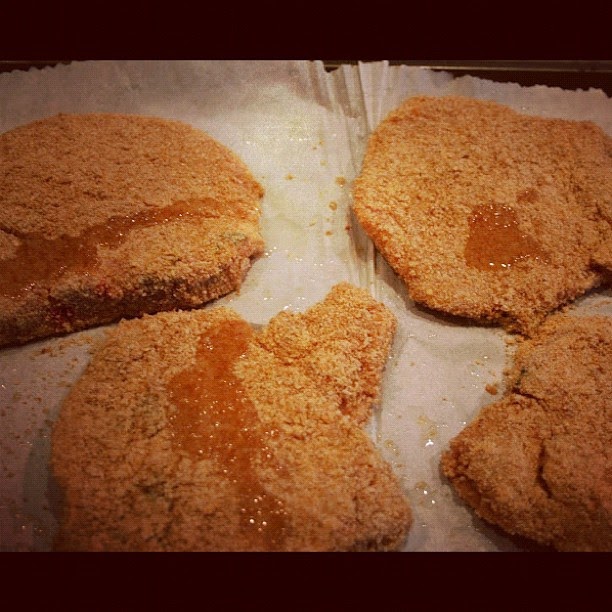
Ready to oven fry!

(14) Put baking sheet into preheated oven.
(15) Bake for 20 minutes.  Turn over gently (using a flat spatula) so as not to disturb breading.
(16) Once flipped, bake for 10-15 more minutes. 
-The idea is to get the crust to set without deep frying it.  The longer cooking times will ensure this.  If you fiddle with it too early, the breading will come off and you will no longer have breaded pork chops - You’ll have pork chops with some breading on them….    
-After this 10-15 minutes, the pork chops will be cooked and the crust will be set.  What I do then is switch the broiler onto high and let them brown to get that 'crispy on the outside, juicy on the inside' effect...(make sure you watch this as they will go from brown to burn quickly!).  

Remove from the oven and serve.

These are great as left overs the next day....just warm em up in a pan and serve.

Happy Cooking!

Wednesday, March 28, 2012

Teriyaki Marinated Salmon Fillet in Phyllo Pastry

So I saw the movie 'Salmon Fishing in the Yemen' a couple of weeks ago - which was the inspiration behind me sitting down to write this post for my favourite salmon recipe.  This movie is probably one of the best romantic comedies that I've seen in a while.  It’s hilarious (which is almost entirely because of Kristen Scott Thomas) and heart-warming.  And come on....the title alone would make me want to see it....

I picked up this recipe from my Sauces and Marinades class.  There is something about wrapping the salmon teriyaki in layers of butter and phyllo pastry that makes it a-mazing (I am sure wrapping anything in layers of butter and phyllo pastry would have the same effect....I might even consider giving tofu another chance if it was wrapped in layers of butter and phyllo pastry....).  I think the phyllo pastry has the added benefit of 'fancy-ing up' (yes, 'fancy-ing' is a word) the basic salmon teriyaki recipe.  Whatever the reason, the combination is delicious.

This is an adapted version of the recipe that was taught in class.  I turned the marinade into a glaze.  I find the glaze holds better to the salmon once it's wrapped in phyllo.  Should you want to be healthy, you can skip wrapping the teriyaki glazed salmon in layers of butter and phyllo pastry and instead pan fry or grill it.   

Also, since salmon has a lot of natural flavour, make sure you use a low sodium soya sauce - otherwise you will end up with a big salty mess.

Teriyaki Marinated Salmon Fillet in Phyllo Pastry
(makes 4-6 servings)

Ingredients:


6 tbsp sherry
1 cup low sodium soya sauce
3 tbsp brown sugar
2 tsp sliced ginger
4 tsp crushed garlic
1 1/2 pounds salmon fillet
1 cup unsalted butter
1 tsp crushed garlic
1 box phyllo pastry
Sesame seeds
1 package panko bread crumbs (can be found at most grocery stores in the 'Asian foods' section)
1 cup sour cream
Lemon zest (to taste)
Chives

Directions

Glaze:
(1) Combine sherry, soya sauce, brown sugar, ginger and 2 tsp sliced garlic in a small pot
(2) On medium heat, simmer slightly for about 20 minutes, stirring occasionally
-be careful not to turn the heat up too high, the sugars in the sherry and the brown sugar will burn and give your sauce a bitter taste
(3) Once mixture has thickened (to the consistency of a syrup) remove from heat and let cool completely

Sherry, soya sauce, brown sugar, ginger and garlic....
Salmon:
(1) Remove the skin from your salmon fillet; Trim off any bits or grey fat
(2) Cut the salmon fillet into serving sizes
-you might want to consider making the serving sizes a little smaller if you intend on wrapping it in Phyllo
(3) Rinse salmon pieces and pat dry

Assembly:
(1) Brush both sides of each salmon piece with glaze.  Let this air dry and then repeat.
-do this on a rack so the excess marinade can drip off
-it doesn't have to be completely dry.  I would give it 10-15 minutes between brushing
***Optional (if not wrapping in phyllo) - At this point you can either grill or pan fry or broil your salmon - basting with any remaining glaze if you so desire***
(2) When salmon has been brushed with a second coat of the glaze and is drying, in a small saucepan, melt butter over medium-low heat.  Add 1 tsp of crushed garlic to butter and let cook for about 30 seconds .  Remove from heat, but don't allow this to cool (to avoid the butter congealing).
(3) Put the panko bread crumbs in a bowl; set aside.

Wrapping Salmon in Phyllo...
As soon as Phyllo senses air, it dries out QUICKLY.  Once it dries out, it will get hard and flaky and eventually you will not be able to work with it.  To avoid this I usually grab a section of damp paper towel (about the size of 1 sheet of phyllo) and cover any unused phyllo while I am working.  This doesn't stop the drying out completely, but it definitely helps.  Also try to avoid working with phyllo near any type of heat source....
Remember to keep phyllo pastry covered with a damp paper towel!
(4) Working quickly, lay out one layer of phyllo on a clean dry counter top; Using a pastry brush, cover the layer with the still warm (so it's still liquid-y) garlic butter.
Alternately, you can cut 1 layer of phyllo into two and use the halves to create layers...
(5) Grab a second layer of phyllo, place on top of first layer
-butter adds flavour but also acts as a glue to keep the layers of phyllo together
(6) Cover the second layer of phyllo with garlic butter
(7) Grab a third layer of phyllo and place on top of the second (remembering to keep unused phyllo covered with damp paper towel), cover the third layer with garlic butter
(8) Put a mound of panko bread crumbs in the middle of your pastry
(9) Place a piece of salmon on top of the panko crumbs
-The bread crumbs are there to absorb any excess moisture
Salmon on top of panko, ready to be wrapped in phyllo!
(10) Enclose salmon in phyllo
-this can be done any number of ways.  I usually wrap the salmon with the phyllo dough like an envelope.  This has the added bonus of creating more layers of phyllo-buttery goodness.
-be sure to use the garlic butter as a 'glue' to ensure that all folded ends of the pastry and 'glued together'
(11) Place folded side down on baking sheet.  Brush top with butter and sprinkle with sesame seeds. 
Ready to be baked!
(12) In a 450 degree oven, bake for 15-20 minutes
-Check periodically to ensure that the pastry is not burning
(13) Remove from oven and serve with sauce (below)
So good!
Sauce:
Combine sour cream with lemon zest (to taste).  I usually put about 1/2 tsp of lemon zest.  Garnish with chives.

Salmon can be served with a quick green bean almondine....
Happy Cooking!

Monday, March 12, 2012

Sauces and Marinades

Sauces and Marinades is a 6 week course offered at George Brown College through their Continuing Education program.  The main focus of this course is marinating different types of meats and fish, and then either creating a sauce out of that marinade, or pairing the dish with an accompanying sauce. 

The instructor for this course was fantastic.  She taught us to analyze and dissect each recipe in order to really question and understand why each step was included - which helped to further my quest to be able to 'cook without a recipe'. 

Week 1: Mmmmm...Carbs....
First class.  This was a demo-only class.  The instructor provided an introduction to the properties of sauces and marinades and the flexibility that these provide a cook in the kitchen. 
Demonstrated in this class were sauces specifically for pasta.  All of the sauces tasted awesome (It's not too surprising that I found all of these recipes amazing...I do love me some carbs...).  There was a Three Green Pasta with Scallops and Pesto Sauce - this pasta had peas, pesto (making pesto was part of the demo as well) and asparagus (hence - three green) and a healthy dose of whipping cream.  When I've made this at home, I replaced the whipping cream with skim evaporated milk and it actually tasted great.  There was a Spagettini Col Sugo Di Erbe E Pomodoro Crudo, which was a lovely basil/sage/rosemary/mint tomato sauce.  It tasted amazing with olive oil and parmesan cheese (I never would have thought to put mint into a tomato sauce...).  There was a Pasta with Sun Dried Tomato in Cream Sauce.   I loved the flavours of the red pepper and sun dried tomato.  There was also a Pasta with Cream Wild Mushroom Sauce.  This sauce had dried wild mushrooms (which were rehydrated), white wine, shallots and (you guessed it) whipping cream.  Rich, but very good.  And lastly, Linguine with Clams in a Spicy Pernod Sauce.  This recipe had fennel which I had not worked with too much before this class, so that was interesting.  Pernod (for those who don't know) is a French liquor (tastes like Anise).  Also, this was my first experience with cooking clams.  So that was it for the first class.  I found these to be very easy, not time-consuming recipes that would work for a weeknight dinner. 

Week 2: Meaty Goodness...
Meat.  This week we covered how to marinate it and how to make lovely sauces to go with it.  Demonstrated was a Filet Mignon with Gorgonzola Sauce, a Marinade for a Flank Steak and a Roast Rack of Lamb with Hazelnut Rub and Blood Orange Sauce.  The Gorgonzola Sauce for the Filet Mignon was a very rich, creamy sauce.  The Cayenne and Thyme added to it was a nice way to break up the creamy-ness of this sauce.  The marinade for the flank steak was zesty and spicy.  It utilized pineapple juice to tenderize the flank steak.  The instructor emphzised that it was essential to marinate tougher cuts (like flank steak) overnight to achieve the correct tenderization.  The Lamb with Hazelnut Rub and Blood Orange Sauce introduced the class to the concept of a 'Gastrique', which is a sauce that has a sweet plus an acid (i.e. Caramelized sugar and vinegar).  The lamb racks are first seared in a hot pan, then they were marinated for a few hours.   They were then covered in a walnut crust and roasted in the oven.  The lamb is served with a blood orange sauce.  It's an impressive recipe that was easy to make once it was broken down.  Grilled Flank Steak with Roasted Shallot Sauce was part of the lab.  In class we made the marinade and added it to the steak.  As it was flank steak, we took that home and let it marinate overnight.  Roasting the shallots before making a sauce added a rich hearty flavour to a simple stock based sauce. 

Week 3: Les Poisson
Fish.  I love learning new fish recipes.  Fish is so healthy and I feel great after I eat it, but sometimes I am at a loss for new ideas on how to make it.  Demonstrated in this class was an Asian Marinated Mahi Mahi Fillet and a Grilled Swordfish with Lentil Ragout and a Horseradish and Apple Sauce.  The Mahi Mahi was simple & flavourful (hoisin sauce and sesame oil) and only required 30 minutes of marinating time, which is great for a weeknight meal.   The Grilled Swordfish with Lentil Ragout (which had bacon – YES!) was a good hearty meal.  I love the texture of Swordfish...it is like the 'meat' of the fish-world.  The labour intensive part of this dish was the ragout, but it's well worth it as a side dish to the swordfish. Teriyaki Marinated Salmon Fillet in Phyllo Pasty with Herb Dressing was part of the lab in this class.  I loved loved loved this recipe.  The salmon is first marinated in a teriyaki-like sauce then wrapped in phyllo pasty, which is sprinkled with sesame seeds.  A sour cream, dill and lemon sauce is made to accompany it.  I've made this a number of times and it has always been a hit.  I'll include my version for this recipe in a subsequent post. 

Week 4: Bock....Bock, bock, bock!
(I've started to see the Cadbury's Easter commercials on TV.  I couldn't help myself). 
As you've probably guessed by now, chicken is the topic of today's class.   A Herb and Buttermilk Baked Chicken Breast with a Creamy Peppercorn Sauce, and a Broiled Chicken with Fresh Peach and Ginger are demonstrated today.  The Herb and Buttermilk Chicken marinade is good for both baked chicken and deep fried chicken.  Marinating chicken in buttermilk really tenderizes chicken, and infuses them with an incredible amount of flavour.  The Broiled Chicken with Fresh Peach and Ginger was interesting - as it combined the flavours of sweet peach and the zing of ginger.  This would be a great marinade for bbq chicken.  The lab for this week included a recipe for Herb Breaded Chicken Breast Stuffed with Goat Cheese and Pecans in a Creamy Mustard Sauce.  This recipe involved flattening and stuffing chicken breasts, breading and baking them and making the accompanying sauce.  The goat cheese pecan stuffing wasn't too overpowering, and went well with the herb breading.

Week 5: Pork
Before this class, I had not worked with pork too many times - so this was a good introduction.  Also, it was interesting to me that about half the class didn't show up - so I ended up with A LOT of extra pork.  (I guess people don't like pork...?)
Demonstrated in this class was Sautéed Medallions of Pork with Red Onion Confit and Cider Bourbon Sauce.  The pork loin for this recipe is first seasoned with salt and pepper, seared on all sides and then cooked off in the oven. The cider/apple/bourbon sauce and red onion comfit combine to create a nice tangy flavour.  Pork Chops with Spicy Citrus Marinade was also demonstrated in this class.  This was an easy (5 ingredients) marinade.  The pork chops themselves require only 30 minutes of marinating in this spicy citrus marinade time prior to searing or grilling.  Grilled Garlic Lime Pork Tenderloin is included in this week's lab.  It's was actually really good.  The marinade helps to tenderized the meat.  It was a combination of soya sauce, gingerroot, mustard and lime juice. 

Week 6:  Food on a Stick...
This week was all about food made and served on a stick (food on a stick is more fun!). 
This week, Yogurt Lamb Souvlakia, Pork Rib Satays, Velvet Chicken Satay, Cilantro Chutney and Garlic-Soy Marinated Beef Strips were demonstrated.  These recipes included great marinades and sauces which would be good for appetizers, and for a BBQ.  'Velveting chicken' essentially means marinating chicken in corn starch and egg white.  This is a Chinese cooking technique which helps to prevent the chicken from overcooking - which is required for chicken satay’s (since the chicken is cut so thin, it's easy to overcook it). 
Chicken Kabobs with Ginger Lemon Marinade and a Pork Satay recipe are included in the lab for this week.  The marinade for the chicken kabobs includes gingerroot, coriander and fennel seeds.  The kabobs are made with green peppers, pineapple chunks and cherry tomatoes.  This is an ideal summer BBQ recipe.  The pork satay is a great basic recipe.... It's a 'Thai' inspired recipe as it uses coconut milk, soya sauce, chilli pepper and cumin.  It’s paired with a coconut milk/peanut butter based sauce.

This course includes a lot of great techniques for marinating and cooking different types and cuts of meats and fish.  As you can see, each class was packed full of many different, usable recipes.  Everything was very flavourful and the instructor was amazing.

Happy Cooking!